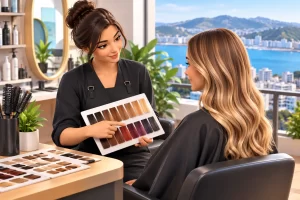
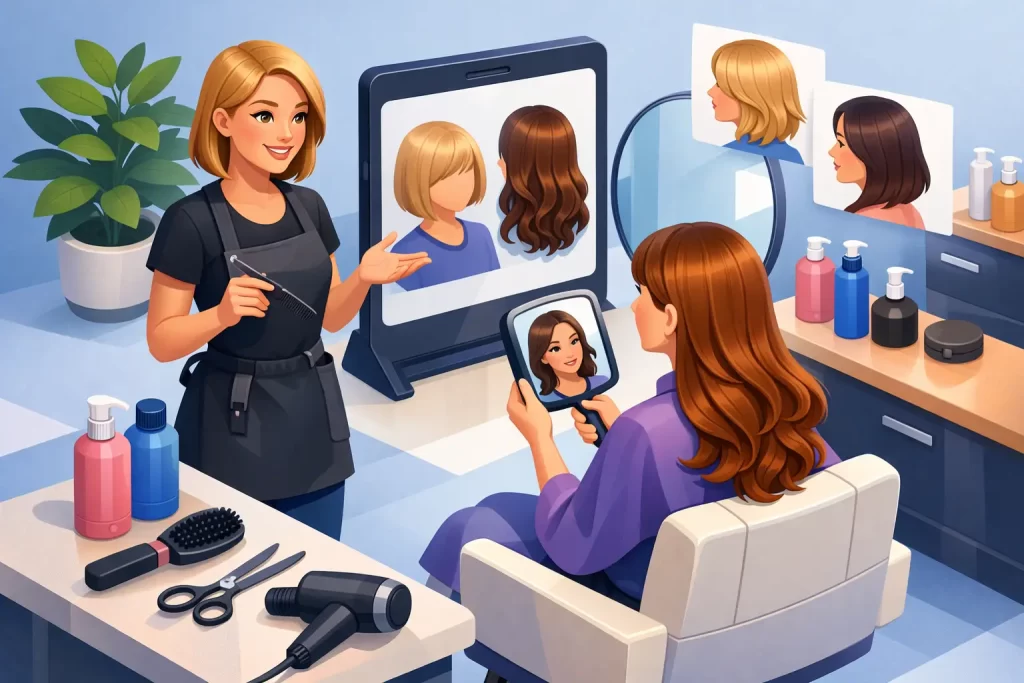
A haircut can look completely different on two people, even when they show the same inspiration photo. Hair texture, density, growth patterns, face shape, and daily routine all affect the final result. Knowing how to explain desired haircut details gives your stylist the information needed to tailor the look to you, rather than simply copy a picture.
The goal is not to learn salon terminology or arrive with a perfect plan. A good consultation is a conversation. The more clearly you can describe what you love, what you want to avoid, and how you live with your hair, the more confident you can feel before the first section is cut.
Start with the result you want to see
Instead of opening with, “Just take off a few inches,” begin with the overall effect you want. Do you want your hair to feel lighter? Look fuller? Sit neatly around your face? Grow out with minimal maintenance? These goals help your stylist decide whether a blunt cut, soft layers, face-framing pieces, texture, or a different shape will serve you best.
Be specific about what is bothering you now, too. You may feel that your ends look thin, your current layers are too short, your hair gets bulky at the sides, or your bangs take too much effort every morning. Sharing the problem is often as useful as sharing the desired solution.
It also helps to say what you do not want. If you have had layers that made your ponytail feel sparse, a bob that flipped out at the jawline, or bangs that required daily heat styling, mention it. Your stylist can make thoughtful adjustments when they understand your past experiences.
How to explain desired haircut length clearly
Length is one of the most misunderstood parts of a haircut conversation. “An inch” can look and feel very different depending on whether hair is curly, wavy, fine, thick, or currently damaged at the ends. Rather than relying only on a number, show your stylist where you want the finished length to fall.
Use visible reference points. For example, you might say you want your hair to sit at your collarbone, skim the top of your shoulders, reach the middle of your neck, or remain long enough to fit comfortably into a ponytail. If you are keeping length, say that directly: “I want to remove the damaged ends, but preserving length is my top priority.”
For curly or textured hair, discuss shrinkage. A curl pattern may spring up significantly once dry, so the wet length is not the final length. Ask your stylist how much your hair is likely to contract and confirm where the curls will land after the cut.
Talk about the perimeter and shape
The perimeter is the outline of the haircut at the bottom. You do not need to use that term, but you can describe what you see. Do you want the ends to look full and blunt, softly rounded, slightly angled forward, or more textured and airy?
A blunt perimeter can make fine hair appear denser and more polished. Softer or textured ends can reduce heaviness and create movement, especially in thicker hair. Neither option is automatically better. The right choice depends on your hair type, desired styling routine, and the amount of visual fullness you want.
Bring photos, but explain what you like about them
Inspiration photos are useful because they give a stylist a quick visual starting point. Bring two or three images instead of twenty. Choose photos of people with hair that is reasonably similar to yours in texture, density, and natural movement when possible.
The most helpful part is explaining what attracts you to each image. You may love the movement around the face in one photo, the fullness at the ends in another, and the easy grow-out of a third. This gives your stylist permission to combine the qualities you like into a haircut that works for your own hair.
Photos can also help you communicate what you want to avoid. If a style looks beautiful but feels too short, too heavily layered, too round, or too high-maintenance for you, say so. A consultation should translate inspiration into a realistic, personalized plan.
Remember that styling, lighting, extensions, and filters can change how a haircut appears online. Your stylist should be honest if the photo requires a level of daily styling that does not match your routine. That conversation protects you from leaving with a style you love in the chair but struggle to recreate at home.
Describe your everyday styling routine
A flattering haircut should support your real life, not just a special occasion. Let your stylist know how often you wash your hair, whether you air-dry or blow-dry, and how much time you are willing to spend styling each morning. Five minutes and thirty minutes are two very different haircut plans.
Mention the tools and products you actually use. If you never pick up a round brush, avoid agreeing to a shape that needs a daily blowout for volume. If you frequently wear your hair up for work, workouts, or Florida humidity, ask whether the shortest layers or face-framing pieces will stay secure in a ponytail.
Your natural texture matters here as well. Someone with fine, straight hair may want strategic layers for lift, while someone with thick, wavy hair may need internal weight removal to prevent a triangular shape. On the other hand, too much thinning can make some hair types frizzier or leave the ends looking weak. A trained stylist can explain the trade-offs before cutting begins.
Discuss maintenance before making a major change
Every haircut has a maintenance rhythm. A crisp bob, short fringe, or heavily shaped cut may need more frequent appointments to keep its intended form. Long layers and softer face framing often grow out more gently, though they still benefit from regular trims to maintain healthy ends.
Be upfront about how often you want to visit the salon. If you prefer appointments every eight to twelve weeks, say that. If you are happy to return more often for precision maintenance, your stylist can recommend options that hold their shape beautifully between visits.
This is especially valuable when adding bangs. Ask how they will behave with your natural part, cowlicks, and humidity. A wispy fringe may be easy to style for one person and surprisingly demanding for another. There is no harm in choosing a longer, softer version first and adjusting shorter at a future appointment.
Ask questions during the consultation
You deserve to understand the plan before the haircut starts. If your stylist recommends a change you were not expecting, ask why. A professional should be able to explain how the cut will work with your texture, whether it will support your styling habits, and what it will look like as it grows out.
Useful questions include: “Will this still fit in a ponytail?” “How will this look if I air-dry?” “Where will the shortest layer fall?” and “What should I expect after a few weeks?” You can also ask your stylist to show you the intended length with their hands before they begin.
Speak up early if something feels unclear. It is much easier to adjust the plan before the cut than to correct a misunderstanding afterward. Clear communication is not being difficult. It is part of creating a service that feels personal and collaborative.
Trust the professional perspective
The best haircut appointments balance your preferences with your stylist’s training and experience. You know your lifestyle, comfort level, and personal style. Your stylist understands how hair behaves, how to create balance, and which techniques will help your chosen look work beyond the salon mirror.
At Visions Hair Studio, a consultation-led approach means taking time to listen before recommending a personalized direction. Sometimes that means confidently moving forward with a noticeable change. Other times, it means suggesting a more gradual version that protects your length, works with your texture, or makes sense for your maintenance goals.
A great haircut should feel like you, only more polished. Bring a few clear references, describe your routine honestly, and share your non-negotiables. When you and your stylist begin with the same picture in mind, you can relax into the appointment and look forward to seeing your best hair take shape.